Rampant crime challenges the chief minister's promise to maintain law and order. But some say there are other forces at play.
It is as much about farmer woes and the lack of job opportunities as about the mixing of religion and politics.

Meet Cassie de Pecol, a 27-year-old traveller from Connecticut, United States, who visited 196 countries in 18-and-a-half months, making her the fastest person to visit every country in the world.

'We rarely choose to fight when the threat is still a nascent threat. When we do fight, we fight when the invaders reach Panipat and are preparing to knock on the gates of Delhi.'

'We should hit Pakistan, continue to prepare for surgical strikes, continue to punish Pakistani posts in the proximity of the LoC and we should start adopting counter terrorist measures.' 'That should be India's action without escalating it to a full-fledged war.'

'Continuity in a common agenda is essential, not to disrupt the progress achieved so far,' says Ambassador T P Sreenivasan.

The main culprit in vitiating the inter community/caste/class relations has been the so called 'targeted' approach. This is nothing but discrimination on the basis of faith/caste/class. When an equally poor and deprived child is denied scholarship, despite equal merit, resentment begins to brew, says Colonel (retd) Anil Athale.

The prime minister's visit to Washington should focus more on shopping for energy security and stopping the US from snooping on us, reigning in its popular and innocuously operated instruments to gather intelligence like Google, says Tarun Vijay.
Coming down heavily on Pakistan, President Pranab Mukherjee has said unless it dismantles the terror infrastructure on its soil, there is no scope for progress in talks between the two countries.

The BRICS summit made clear that China's support for Pakistan is unwavering. China will continue to pressure India to ease tensions with Pakistan and resolve the Kashmir dispute.

News of all that's transpired on and off the football field
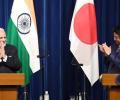
'Relations between India and Japan are robust and devoid of either shadow of history or any irritant.' 'In fact, there is plenty of warmth and goodwill earned over history. There are no negatives but only opportunities,' notes Dr Rajaram Panda.

'Overlying his idealism was a hatred of war and of all things military. He gave no deep thought to politico-military matters and this prevented him from making sound security decisions.'

Addressing a joint session of Parliament on Monday, President Pranab Mukhejee spelled out the Narendra Modi's government's agenda. Here are the highlights of his speech,

'The Indian government has accepted and is a party to international agreements, standards and conventions on religious freedom.' 'We did not force it on them. We are not trying to impose something on them that they haven't already agreed to...' 'India has never allowed us to visit, which is very disappointing for such a wonderful country with such a rich democratic tradition. They seem to be afraid to let us in.'
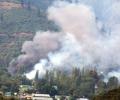
'Knee jerk reactions are the worst in this kind of conflict situation.' 'The responses have to be thought through for strategic advantage rather than tactical satisfaction and ego,' says Lieutenant General Syed Ata Hasnain (retd), former commander of the Uri-based Kalapahar Brigade.

Amid souring ties, the president visited Beijing for three days. On his return to India, a hope of better ties has arisen, says senior correspondent R Rajagopalan, who travelled with Pranab Mukherjee to the Asian superpower.
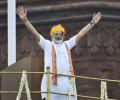
Following is the full text of Prime Minister Narendra Modi's address from the ramparts of the Red Fort on the 73rd Independence Day.
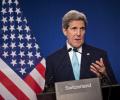
At scaling back Tehran's nuclear programme and relieving the Islamic Republic from the sanctions

'The US wants Modi to succeed because we want India to succeed. For our part, when India thinks of its partners in the world, we want it to think of the US first. That means positioning our country as the preferred provider of the key inputs that can help to propel India's rise.' 'The meeting between Modi and Obama is, and must be, an opportunity for true strategic dialogue -- not a scripted exchange of talking points, but an open discussion of the big questions. What kind of world do we want to live in? What are our true priorities? And most importantly, why does this partnership still matter?'

'No PM has said no to anything we have proposed. I am not a politician and I cannot give speeches about things, but a lot of good things have been done in science by previous governments.' 'Under Dr Manmohan Singh, we could do a few important things. I used to meet him once in 6, 8 weeks. He often said, 'Professor Rao, you assume that you have my approval and carry on.' He was shy and decent. He is a real gentleman.' 'Science keeps me going at 80. I feel young.' Professor C N R Rao, the eminent scientist who was honoured with the Bharat Ratna, on the state of science in India.

'The BJP has latched on to the idea of nationalism, but the nationalism they advocate is not nationalism as we have understood it since the time of the freedom movement.' 'This is not secular nationalism, it is Hindu nationalism.' 'It is a form of nationalism that is exclusionary and it tends to conflate national interest with the government.' 'So, if you disagree with the government, for example, on surgical strikes or demonetisation, you are anti-national or holder of black money.'

AAP candidates from Mumbai, Medha Patkar and Meera Sanyal, are poised to play a crucial and complementary role. While Patkar gives voice to the suffering of people at the grassroots, Sanyal is articulating the key principles that could build a more just and equitable society or economy, says Rajni Bakshi.

'The Opposition has no option but to make it an 'All versus One' fight to even think about winning.'
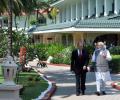
Big ticket defence deals including purchase of missile systems, frigates and joint production of helicopters were sealed on Saturday.

In this May 2014 interview with Vaihayasi Pande Daniel/Rediff.com, the politically conscious Karnad spoke of why he is concerned about Modi coming to power.

'The strategy has to be restoring order in one part and countering the very effective propaganda through a very nimble monitoring and response system,' says Lieutenant General Syed Ata Hasnain, who retired as the General Officer Commanding of the Srinagar-based 15 Corps.

'Your constant reiteration on the lack of religious freedom in India has sown doubts about the kind of information that you are being fed and based on which you seem to be making adverse references to India and its tradition of religious tolerance.'

For 70 years the country has been looted, give me 70 months I will clean it up, he said.

Continued uncertainty or confrontation in the Asia-Pacific is clearly in no one's interest as it will affect major powers' attempts to restructure their economies and revive growth. Conflict would roll back the gains to each of our countries of 40 years of stability and peace, says Shivshankar Menon.
A sensational interview on India-China ties, with the man most qualified to answer.
'There is a problem with the rise of a popular view that sees Kashmir through the prism of the larger, chronic Hindu-Muslim tensions.' 'By redefining the Kashmir problem simplistically in Hindu-Muslim terms could end up keeping Kashmir but losing most Kashmiris,' says Shekhar Gupta.

Nine young men killed in police firing last August have become symbols of oppression of the tribals of Manipur.

President Pranab Mukherjee on Monday addressed the first joint sitting of Parliament as mandatorily required under the Constitution after the general elections. The address is the political, economic and foreign policy road map of the Narendra Modi government and covers virtually all crucial areas.

'It is for the first time the voices of the most deferred, the most neglected, the most ignored, the most abused, the most vulnerable - the children-- has been heard. It is a great moment.' 'I always wanted Pakistan and India to have good relationships because I believe that this is very important for the development of both the countries.' 'If children are taught hatred, if they are taught about sectarianism and prejudice, then we can see that there will be terrorism in society." Nobel Peace Prize winners Kailash Satyarthi and Pakistan's Malala Yousafzai were given an ovation after they delivered their rousing speeches in front of a packed audience at a glittering ceremony in Oslo on Wednesday. A day later, they sit down for an interview with CNN's Christiane Amanpour and share their dreams, their hopes for the future. Read excerpts from the interview.

Pope Francis on Friday called upon the world community to put aside their "partisan interests and sincerely strive to serve the common good".

Veteran scientist P M Bhargava will return the awards he received from the government of India to protest against "the government's attack on rationalism, reasoning and science."

'The BJP politics of appropriating icons from its ideological adversaries could only be a desperate attempt to extend the Jat-Muslim divide in Uttar Pradesh. Why this desperation when it can comfortably get votes on the plank of economic development?'

The demand for OROP has been projected as an unambiguous issue but a good policy argument must have a sound economic element.
'To re-establish the writ of the State and resume governance, frayed tempers in the streets and in the media need to be calmed.'
 © 2026 Rediff.com - Advertise with us - Disclaimer - Privacy Policy - Sitemap - Feedback - About us - Terms of use - Grievances